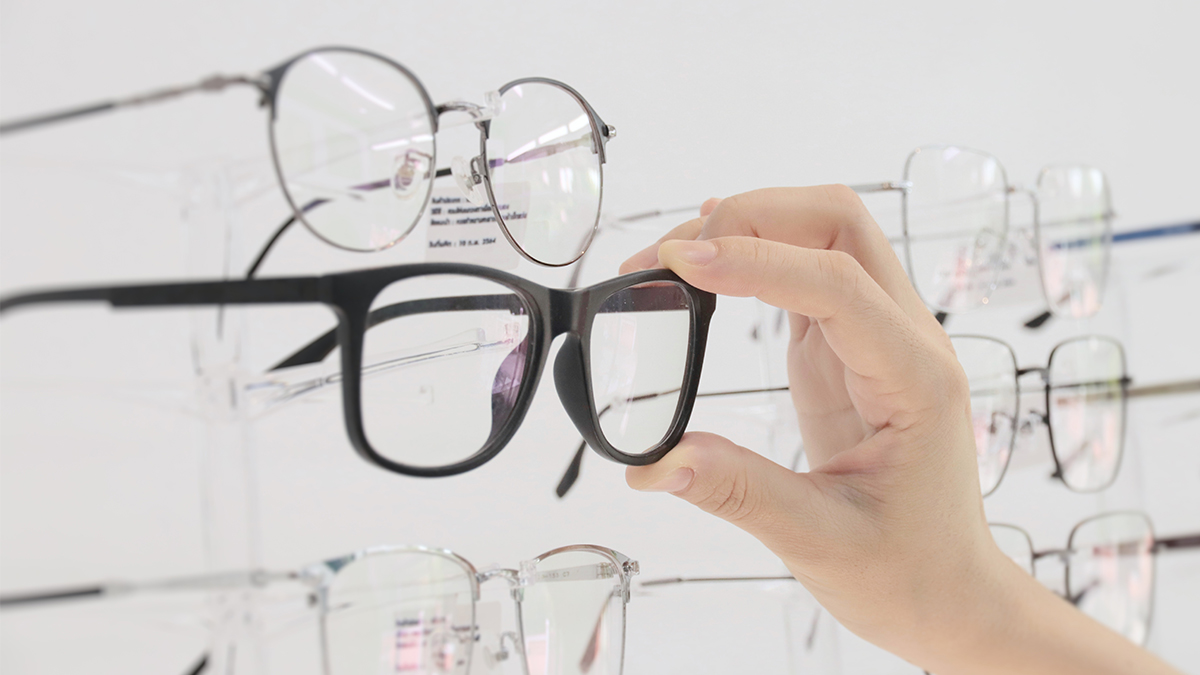
Finding the right eyeglasses isn’t just about fashion — it’s about comfort, fit, and optimizing your vision. As an optometrist, I often get questions from patients about how to choose the best pair. Here are the five most important things to consider when selecting eyeglasses.

Dr. Neelam Patel Magan
Doctor of Optometry
What’s the most important factor when choosing frames?
Frames should complement your face shape, personal style, and fit comfortably. A well-fitted frame sits evenly on your nose without pinching or slipping so make sure your eyecare professional is checking this.
Frame size matters too. It’s important to choose a frame that works with your prescription and pupillary distance (PD), the distance between your pupils, not just for aesthetics. A frame that is too large can cause the lenses to be thicker, even if you choose high-index material. This is especially relevant for stronger prescriptions, where lens thickness and weight can significantly impact comfort and appearance. Additionally, if the frame is too large, it may slide down your nose, affecting how you see through your lenses. If it’s too small, it can create pressure points and discomfort. More importantly, an improperly sized frame can impact the accuracy of your prescription. The way your lenses sit in relation to your eyes affects how well they correct your vision. If the optical center of the lens isn’t aligned properly due to an ill-fitting frame, you may experience visual distortions, eye strain, or difficulty adjusting to your new glasses.
Also, consider the material — acetate is durable and stylish, while titanium is a hypoallergenic, lightweight, and incredibly durable metal choice, making it perfect for those with sensitive skin or an active lifestyle.
How do I make sure my glasses fit properly?
Proper measurements are key. One of the most important is your PD. This ensures that the optical center of your lenses aligns with your eyes for the clearest and most comfortable vision. If PD is measured incorrectly, it can cause visual strain, headaches, and difficulty focusing. This is why I always recommend having a professional measure your PD rather than relying on online tools or self-measurements.
The bridge fit prevents the frame from sliding down your nose, and the temple length should be long enough to comfortably extend and be bent down behind the tops of the ears without pressing behind your ears. A poor fit can cause discomfort or even distort your vision. If the PD or lens alignment is significantly off, it can create induced prism, which may lead to symptoms such as dizziness, double vision, or a pulling sensation in the eyes.
What type of lenses should I get?
Your lifestyle and prescription determine the best lenses, and lenses are available in many different materials. Polycarbonate lenses are impact-resistant and an excellent choice for kids because they are both durable and lightweight. High-index lenses are ideal if you have a high minus prescription or high astigmatism, as they reduce thickness and weight, making your glasses more comfortable and aesthetically pleasing.
When choosing sunglasses, always opt for UV protection to safeguard your eyes from harmful rays. Polarized lenses are great for reducing glare, especially driving, water sports or outdoor activities.
Should I choose progressive or single-vision lenses?
This depends on your daily visual needs. If you are a nurse, painter, or someone who dislikes constantly taking glasses on and off, a progressive lens — which provides distance, intermediate and near vision — is a great option.
If you work in finance, accounting, or spend most of your day on a computer or phone, speak to your optometrist about a computer progressive lens offering optimized vision for intermediate and near distances, reducing strain during prolonged screen time.
For those who only need glasses for reading or distance vision, single-vision lenses may be the better option. For example, if you only need glasses for driving or watching TV, single-vision distance lenses are ideal. Likewise, if you strictly need glasses for reading books or menus, single-vision reading lenses may be the simplest and most effective choice.
Overall, be sure to discuss your working distances with your optometrist to get the most accurate prescription.
Are there any additional enhancements I should consider?
Absolutely! I never prescribe a lens without an anti-reflective (AR) coating — it reduces glare, improves clarity, and enhances the appearance of your lenses by minimizing reflections.
Specialty tints can be a great addition aesthetically, but also functionally. A yellow lens enhances contrast and reduces glare, making it beneficial for night driving or low-light conditions. A red lens can help improve contrast for individuals with certain visual impairments or sensitivity to bright light.
Choosing glasses isn’t just about finding a stylish frame — it’s more complex than you might think. By having the right discussions with your optometrist, you can ensure that you’ll not only look great but also see clearly.
