
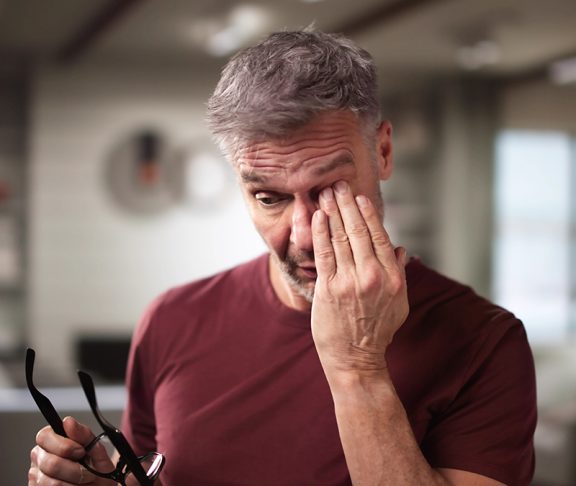
Cataracts can pose significant quality of life challenges, whether they’re hereditary or conditional upon health or lifestyle. Learn more about the causes of cataracts and treatments that can alleviate or remedy severe vision degeneration.
“Lately, my father has been struggling to read even with his glasses. I’m worried his vision is getting worse, and I don’t know how to help. Is there anything that could improve his eyesight, or is this just part of aging?” – Suzy from Denver
If your loved one is struggling with vision, you’re not alone. By the time people reach 80, at least half of the older population will either have cataracts or have had surgery to remove them. Usually, you can tell if your loved one has a cataract due to the distinctive cloudy appearance that results from a clumping of proteins inside the lens. Let’s talk more about what causes cataracts in seniors as well as how to prevent and treat them.
Nature and nurture
Cataracts can be hereditary, but they can also come from other health conditions or lifestyle choices. For example, diabetes can cause cataracts, as can prolonged steroid use, which may be for other health problems. A history of smoking and alcohol use can also lead to cataract formation as well as prolonged sun exposure. Even an eye injury in the past may result in cataracts as a senior. People with lighter colored irises are more likely to develop cataracts than those with darker irises. Cataracts can be mild to severe, and they do get progressively worse, or “ripen,” over time.
Signs and symptoms
Blurry vision is perhaps the most obvious symptom of cataracts in seniors, but it is hardly the only one. Be on the lookout for some of these other signs:
- A halo-like glare surrounding light
- Cloudy images
- A brownish tint or dulled, faded colors
- Poor vision at night
- Double vision
- Frequent prescription changes
Any time your loved one notices vision problems, he or she should visit the eye doctor for a thorough exam. The ophthalmologist may dilate your senior’s eyes to check for cataracts and other conditions, and based on the exam, make recommendations for treatment. There are a variety of eye health concerns to be informed about, and your provider might even offer a diagnosis for a chronic health problem.
Options and treatments
Unfortunately, there is no cure for cataracts, and treatment depends on the severity of the vision loss. In the early stages, simple adjustments such as reading large-print books or listening to audiobooks, using a magnifying glass, or relying on brighter light bulbs may make daily activities and hobbies easier. When outside, your loved one should wear a large-brimmed hat and anti-glare sunglasses to prevent harmful UV ray exposure. A new glasses prescription may also correct some of the symptoms. Check the home environment for any tripping hazards, as falls can occur in seniors with vision problems. Install nightlights in hallways and bathrooms.
If your loved one needs more help than you can provide or you think they might benefit from an assessment, contact an Aging Life Care Professional who can perform a comprehensive assessment and help identify safety concerns and care plan.
Severe cataracts may not respond to these home remedies, and in those cases, surgery may be the only option. Luckily, surgical treatment is common, safe, and effective. Usually, one eye is treated at a time, and the recovery time is roughly four to eight weeks. Because the patient does not need general anesthesia, healing may not take as long as other types of surgery. You can reassure your loved one that cataract surgery has a high rate of success. Additionally, the surgeon can often correct lifelong vision problems by replacing the lens, so that is an added bonus.
Fortunately, cataracts cannot come back after surgery, and if your loved one has a cataract in one eye, it does not mean the other eye will get one.
Schedule regular vision checks for your loved one to keep on top of any problems, and while you’re at it, schedule one for yourself, too.
