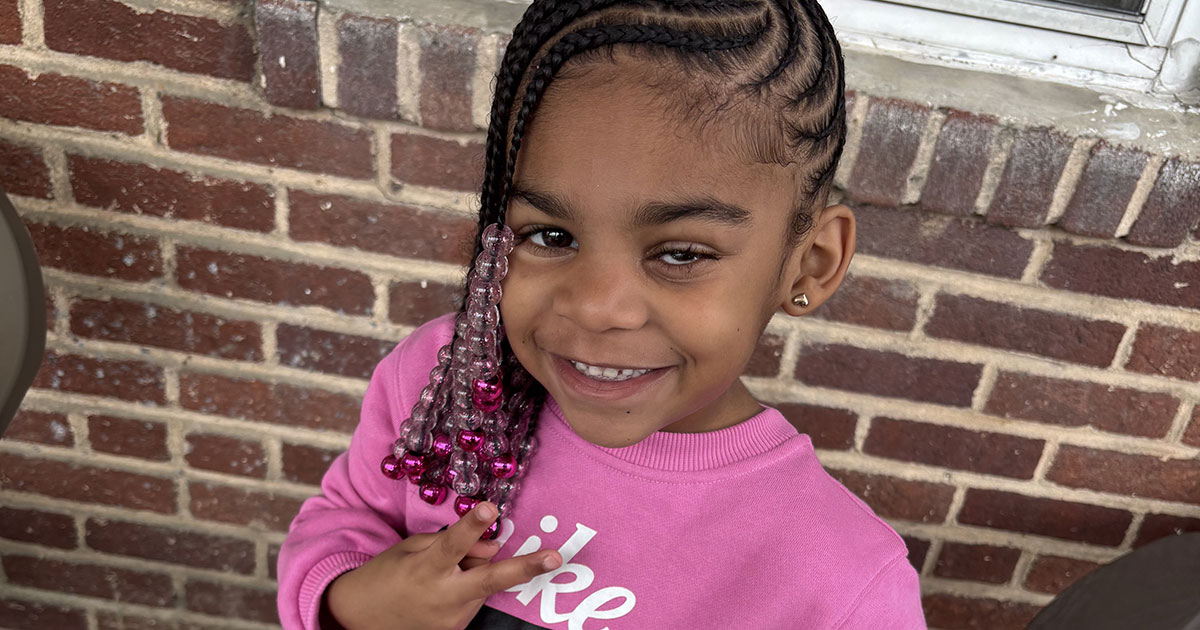
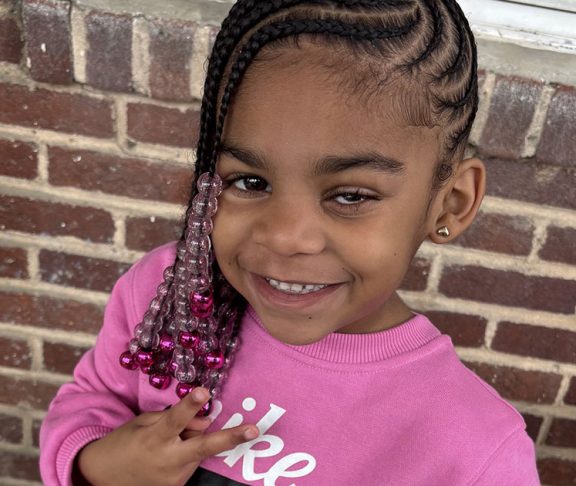
While about 90% of children with retinoblastoma will be cured, permanent visual impairment and long-term eye health side effects are extremely common.
Before her daughter Sa’Mari was diagnosed, Samia had never heard of retinoblastoma, a type of eye cancer that impacts approximately 300 children in the United States each year.
Sa’Mari was just 4 months old when her mom noticed that Sa’Mari’s pupils appeared white in photos. She didn’t think much of it until her pediatrician suggested she see an ophthalmologist.
Sa’Mari had tumors in both her eyes — bilateral retinoblastoma. She’d go on to have chemotherapy, her left eye removed, and receive specialized radiation. Her treatments were a success, and Sa’Mari is a happy, healthy 5-year-old in full remission. But Sa’mari is navigating life with only one eye, a long-term side effect of retinoblastoma that Samia wishes her daughter didn’t have to endure.
While the signs of retinoblastoma can be different for each child, the No. 1 sign is what Samia noticed — leukocoria, a white glow or reflection in the pupil that often appears in photos.
“If I had known about the signs sooner, we could have possibly had enough time to save her left eye as well,” Samia said.
Why early detection matters
Most children with retinoblastoma are diagnosed before the age of 3. While about 90% of children with retinoblastoma will be cured, permanent visual impairment and long-term eye health side effects are extremely common. That’s why early detection matters. Knowing the signs can lead to prompt diagnosis, as can knowing family history. About 40% of children with retinoblastoma carry a mutation in the RB1 gene, meaning the cancer can be inherited.
However, treating retinoblastoma, especially when it is found in both eyes, is still challenging for clinicians. Because eye tumors cannot be safely biopsied, doctors often lack critical information about the chance of relapse and cancer spreading beyond the eye. Families are then forced to make incredibly tough decisions between preserving sight and curing cancer.
A promising new approach
A researcher, funded by Alex’s Lemonade Stand Foundation (ALSF), is working to change that. ALSF is a national nonprofit dedicated to funding childhood cancer research, funding hundreds of grants each year. One grant recipient, Dr. Jesse Berry from Children’s Hospital Los Angeles, is studying how a biopsy of the aqueous humor — the clear fluid that surrounds the eye — could lead to improved diagnostics, more detailed tumor profiling, better treatments, and more cures for kids. These types of liquid biopsies show promise across many types of childhood cancer and offer a less invasive way for doctors to monitor disease and watch for signs of relapse.
“My hope with our research is that we will have a key to how liquid biopsies can benefit all types of childhood cancer research,” Berry said.
ALSF funds research for all types of childhood cancer, including retinoblastoma, through several different grant categories. Learn more about retinoblastoma and the research ALSF funds at AlexsLemonade.org.
