


With Alzheimer’s disease affecting millions of Americans, clinicians need practical diagnostic tools. Blood‑based biomarkers are gaining attention as an accessible approach to evaluating Alzheimer’s pathology.

Diana Dickson
Vice President, Clinical & Regulatory Sciences, Fujirebio Diagnostics, Inc.
Alzheimer’s disease (AD), characterized by amyloid plaques and neurofibrillary tangles, is the most common cause of dementia. An estimated 7.4 million Americans are currently living with the disease, a number projected to nearly double by 2060.1 Although anti-amyloid therapies are now available to slow cognitive decline associated with AD, they work best if given in the early symptomatic stages.2
The challenge is that existing diagnostic modalities have limitations. Positron emission tomography uses radioactive tracers to detect amyloid plaques, but accessibility and unexpected costs make these scans impractical for many patients. Cerebrospinal fluid testing provides another option for evaluating Alzheimer’s disease-associated biomarkers but requires an invasive lumbar puncture. As a result, there is an urgent need for diagnostic approaches that provide accurate results while remaining accessible, economical, and minimally invasive.3
In May 2025, the U.S. Food and Drug Administration cleared the first blood-based in vitro diagnostic test for AD, the Lumipulse® G pTau 217/β-Amyloid 1-42 Plasma Ratio Test. Developed by Fujirebio, this first-in-class blood test is intended for use in adults aged 50 or older presenting signs and symptoms of cognitive decline, as part of a comprehensive clinical evaluation.
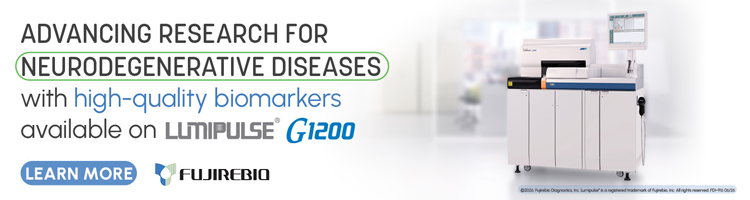
The test is performed on the fully automated LUMIPULSE® G1200 platform, and measures plasma concentrations of two AD-associated biomarkers, pTau 217 and β-amyloid 1-42, from which a ratio is derived. The result helps predict the presence or absence of amyloid pathology associated with AD, and can support clinical decision-making regarding additional diagnostic evaluations and patient management.
Clinicians now have access to a simple, blood-based tool to help determine whether further testing or treatment for AD is warranted.
To learn more, visit us.fujirebio.com/Alzheimers
References:
- Association A. 2026 Alzheimer’s disease facts and figures. Alzheimers Dement. 2026;22:e71345. doi:10.1002/alz.71345. ↩︎
- Ramanan VK, Day GS. Anti-amyloid therapies for Alzheimer disease: Finally, good news for patients. Mol Neurodegener. 2023;18(1):42. ↩︎
- Hampel H, et al. Blood-based biomarkers for Alzheimer’s disease: Current state and future use in a transformed global healthcare landscape. Neuron. 2023;111(18):2781-2799. ↩︎
