


Until recently, a chronic lymphocytic leukemia (CLL) diagnosis came with limited options and a lot of uncertainty. Today, long-term results show how much treatment has changed — and what patients and families should ask about and expect from modern care.
Progress against cancer doesn’t always arrive as headlines. Often, it shows up quietly in longer lives, better tolerability, and higher expectations for what treatment can deliver. The fight against chronic lymphocytic leukemia (CLL), the most common adult leukemia, reflects that kind of progress.
For much of its history, the stark reality of treating CLL meant accepting difficult trade-offs. Early therapies were able to reduce disease burden temporarily, but they did little to change how the disease progressed. Chemotherapy, the main option at the time, functioned as a blunt instrument — attacking rapidly dividing cells broadly rather than addressing the biology driving CLL itself. Patients faced repeat infections that meant hospitalizations, profound fatigue, and immune suppression that left them vulnerable to serious illness. Treatment, in short, was about buying time — not reclaiming it.
That is changing. Over the next few days, more than 40,000 oncology professionals will attend ASCO, the American Society of Clinical Oncology’s annual meeting and the world’s leading forum for cancer research, to debate exactly how far the field has come and where it goes next.
This year’s meeting theme is The Science and Practice of Translation: Improving Cancer Outcomes Worldwide. It is an apt frame for a conversation about CLL, where progress is increasingly defined not only by what’s possible in clinical trials, but by what patients can count on over years: durable control, manageable side effects, and the ability to keep living their lives. The trajectory in CLL shows what scientific translation looks like when it’s done well.
When BeOne Medicines was founded 15 years ago, it was in response to a known gap in oncology that was impossible to ignore. Too often, the goal was managing cancer rather than changing its course. With BeOne, the company made a deliberate choice to understand CLL at a deeper biological level and to discover and develop therapies designed for durability, not short‑term gains.
Fast forward to today. Foundational leadership in CLL has never been about incremental gains. It requires long-term investment, scientific rigor, and a willingness to raise the bar for what patients and physicians should expect from modern medicine.
CLL progress, over time
Long‑term data have fundamentally changed how progress in CLL is measured. Each data point represents a moment when expectations shifted, and outcomes improved.
Chemotherapy: the backbone of CLL treatment in the early 2000s
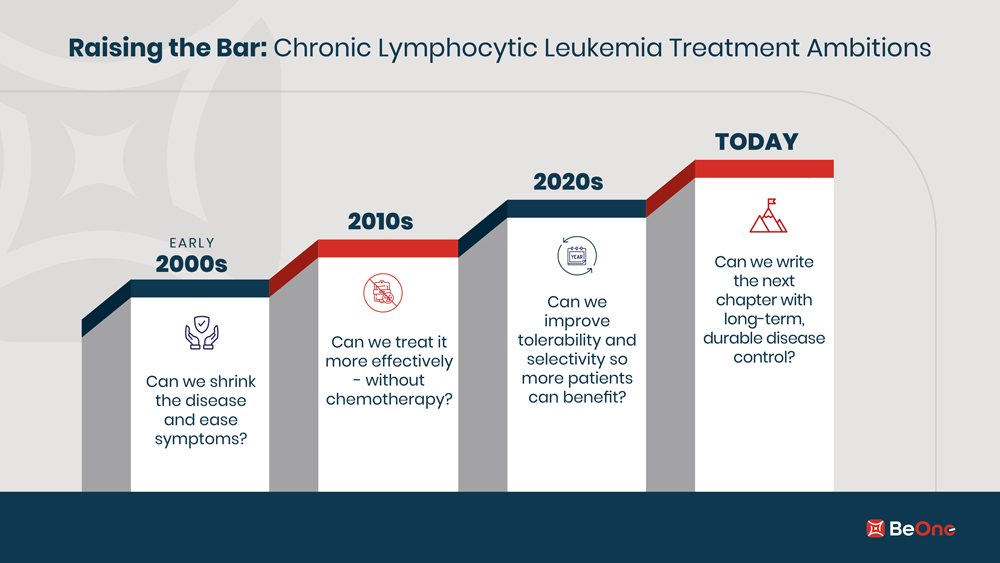
For years, chemotherapy defined CLL treatment, but it was never designed for long-term outcomes. While chemotherapy could shrink the disease and ease symptoms in the short term, it rarely delivered lasting disease control. Responses often diminished over time, relapses were common, and side effects accumulated with repeated treatment.
Because chemotherapy suppresses the immune system, patients faced increased infection risk and lasting impacts on overall health. In practice, this meant that “slowing the disease” often translated into temporary relief rather than meaningful long‑term control — a reality that left many patients cycling through treatment without a clear path forward.

The shift to targeted therapies
BTK inhibition — a targeted treatment that blocks BTK, a protein that helps CLL cells grow and survive — marked a genuine inflection point in the history of CLL. For the first time, the premise of treatment shifted from managing a disease to the possibility of long-term control. Patients had access to an effective, chemotherapy‑free approach that meaningfully extended survival and, critically, changed what living with CLL could look like.
Second-generation BTK inhibitors further refined the approach, improving selectivity and tolerability, and addressing limitations seen with earlier therapies. It was meaningful progress — but still not enough. What the field understood was that BTK inhibition worked. The question became how to make it work better, more consistently, and across the full spectrum of patients who needed it.
Building on the progress of the first-generation BTK inhibitor, BeOne designed its BTK inhibitor to more effectively and precisely block the signals that help CLL cells survive, and to keep doing so consistently over time. In a head‑to‑head clinical trial, BeOne’s BTK inhibitor became the only therapy in its class to demonstrate superior progression-free survival compared with the first-generation BTK inhibitor, setting a new benchmark for what optimized BTK inhibition can achieve.
Why long-term follow-up in CLL matters
In a disease where patients may remain on therapy for many years, long‑term follow‑up is essential. CLL is often managed as a chronic condition, with patients living a decade or more on continuous or sequential therapies.
That reality places a responsibility on innovators to understand how treatments perform year after year — not just at early readouts.
Against that backdrop, the six‑year data from BeOne’s Phase 3 study in patients with treatment-naïve CLL illustrate meaningful progress. Initially presented at the 2025 American Society of Hematology Annual Meeting, the results showed a six‑year survival rate of 84% — a measure that can give patients and families new hope. It is precisely this kind of long-term data that the oncology community is looking for as it considers what the next chapter of CLL treatment should look like.
Long-term follow-up doesn’t simply reinforce what a therapy can do in a trial; it helps patients and clinicians make real decisions with more confidence about staying on treatment and living with it.

What’s next in CLL treatment — moving from surviving to thriving
After decades of progress, the question is no longer whether we can control CLL, but how consistently we can achieve long-term, durable disease control across patients.
At BeOne, the question that has guided its work in CLL has always taken a long view; not “what does this drug do at six months?” but “what does this patient’s life look like at year three, year five, year 10?” That long horizon shaped how it designed its foundational BTK inhibitor, how its structured its trials, and what it continues to demand of every program in our pipeline.
Our expectation is simple and bold. Patients diagnosed with CLL should expect — and demand — long-term disease control with minimal disruption to their lives.
-John V. Oyler, Co-Founder, Chairman & CEO, BeOne Medicines
Looking ahead, BeOne believes “better” in CLL should be defined by three aspirations:
- life expectancy that approaches that of the general population
- time-limited regimens that aim to match the long-term outcomes of the best continuous therapies; and
- treatment approaches that support quality of life, simplicity, and convenience.
The progress made in CLL over the past two decades has been profound. Patients are living longer. Treatments are more targeted. And for many, the disease no longer defines every aspect of their lives.
But progress does not mean the journey is complete. For too many patients, disease control still does not last as long as it should. Infections remain a serious risk. Side effects can limit how long therapy can be sustained. In a disease treated over many years, durability is not a nice‑to‑have; it is the measure that matters most.
That is why at BeOne, continued innovation in CLL must take the long view. Patients deserve treatments that are designed, and proven, to work not just in early readouts, but year after year. They deserve therapies that support long lives, lived well.
Together, we are how the world stops cancer.
To learn more, visit beonemedicines.com
