For many women, a mammogram at 40 is essential, but certain risk factors may make it insufficient on its own.

Wendie Berg, M.D., Ph.D., FACR
Professor of Radiology, University of Pittsburgh School of Medicine; Chief Scientific Advisor, DenseBreast-info.org
Most patients who develop breast cancer do not have any risk factors other than being a woman and getting older. For most women, screening for breast cancer should start with mammography at age 40 and continue yearly. Annual mammograms reduce the chance of dying from breast cancer by about 40%.
However, some women are at high risk and should start screening earlier and with an MRI. This may be because of a disease-causing mutation, most commonly in BRCA1 or BRCA2. Such mutations are more common in Ashkenazi Jewish and Black women. Women at high risk because of such mutations are recommended to start annual screening with MRI by age 25 and to add mammography after age 30. Prior chest radiation therapy before age 30 (and at least 8 years earlier) also creates a high risk for breast cancer, as does a personal history of breast cancer.
Combinations of other risk factors, including dense breasts, may also put a woman at high risk, and prompt recommendation for screening MRI in addition to mammography. Screening MRI can be performed as a “fast” or “abbreviated” MRI in some centers, and can be billed to insurance (often with copay). Some centers direct bill to patients.
All women should have a formal risk assessment by age 25 and then every few years if there is new family history, a new breast biopsy, or if other risks develop. A lifetime risk of 20% or more is considered “high risk.” Over 20% of women in their 40s are at high risk, but fewer than 1% of women in their 70s are at high risk, and screening MRI is not usually recommended beyond age 70.
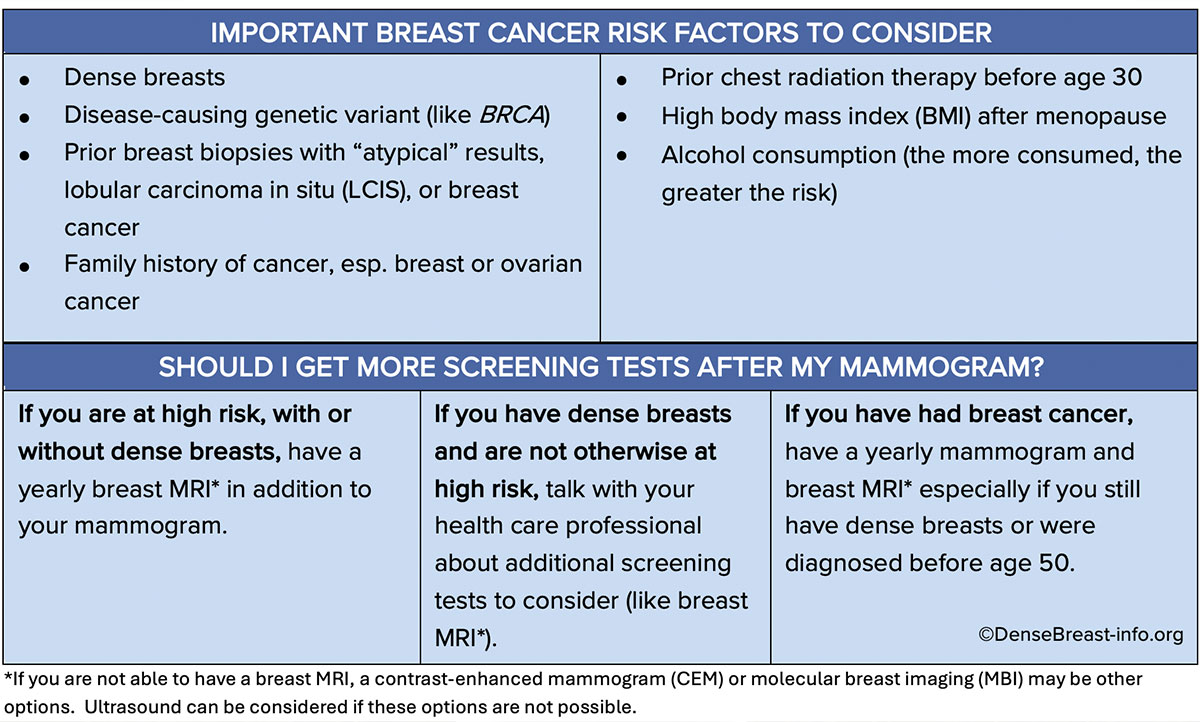
When MRI screening is needed
Because of both a higher risk of developing cancer and of cancer being missed on a mammogram alone, the following women should consider having a screening MRI in addition to a mammogram:
- Women with extremely dense breasts
- Women with heterogeneously dense breasts and either or both of:
- a family history of breast cancer, especially if the diagnosis was before age 50 in the mother or sister, or in two or more relatives on the same side of the family
- prior breast cancer, atypical biopsy, or lobular carcinoma in situ
- Prior breast cancer diagnosed before age 50, even if the breasts are not dense
Other risk factors to consider include:
- High body mass index (BMI over 25) after menopause
- Consuming alcohol, even as little as one glass of wine per day; risk increases with increasing alcohol consumption.
Contrast-enhanced mammography (CEM) may be an option instead of MRI, and it includes images that are like a routine mammogram. CEM requires intravenous iodinated contrast (as in CT scans) and uses the same positioning (and compression) as a regular mammogram, but CEM is not yet FDA-approved for screening. A few centers offer molecular breast imaging using radioactive material to screen women with dense breasts, but this is not widely recommended. When these options are not possible, ultrasound should be considered.
