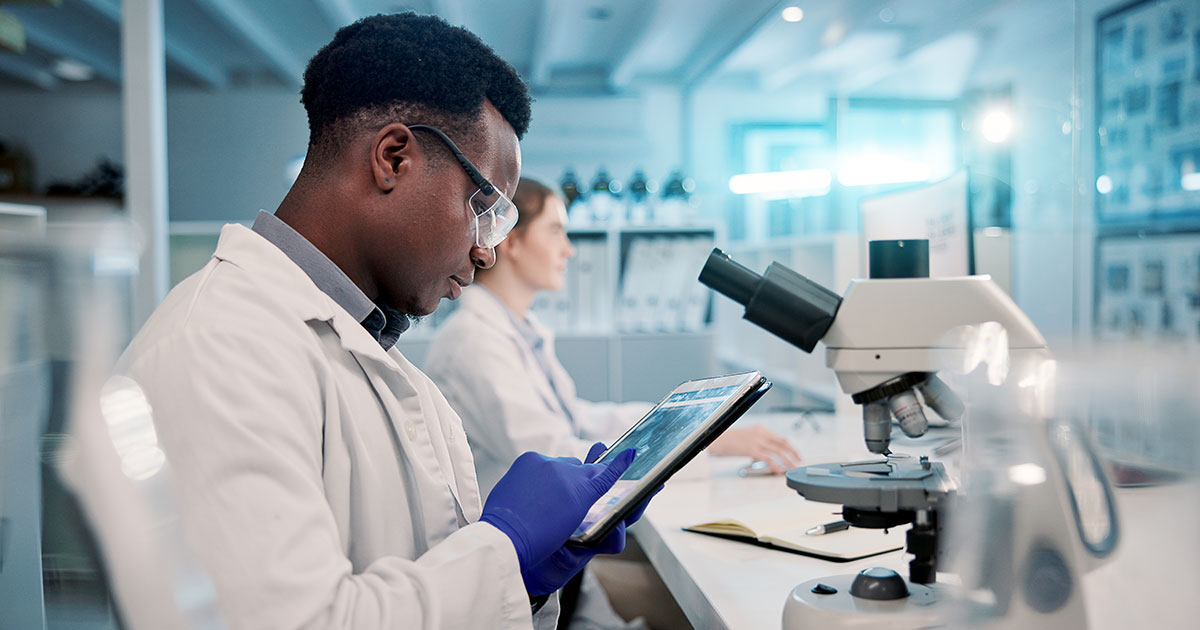
Before a gut health diagnosis is made, pathologists and laboratory professionals are doing critical, often unseen work on behalf of every patient.
When you visit a doctor for gut issues, a lot happens before you ever get a diagnosis. Much of that work takes place in the medical laboratory. While patients may be less familiar with this part of their care, pathologists and laboratory professionals are working hard on their behalf every single day.
Your digestive system is not simply a tube that food passes through. “The GI tract is intricately connected to so many of our other organ systems,” says Danielle Fortuna, M.D., a pathologist at the Hospital of the University of Pennsylvania. “Because of this amazing interplay, digestive complaints — such as nausea, vomiting, diarrhea, and abdominal pain — are not entirely specific on their own and could be manifestations of various clinical issues localizing to various organs.”
That complexity is exactly why the laboratory is so important. When symptoms can point in many directions, laboratory tests can help determine the right path.
When tissue tells a story
When you show up with digestive complaints, your doctor may order a panel of blood tests to get a baseline picture of what is happening inside your body. These can detect any number of digestive issues, from infection to inflammation. Stool testing can also check for infectious pathogens, explains Lindsey Westbrook, M.D., a pathologist at the University of Colorado Hospital, and can point to potential inflammation in the bowel. The lab can also run tests for autoimmune markers for celiac disease or autoimmune gastritis.
But blood and stool tests are often just the beginning. If your gastroenterologist performs an endoscopy or colonoscopy and takes a tissue sample (biopsy), that sample goes to a pathologist for diagnosis.
“There are certain things that can only be diagnosed microscopically. We’re actually looking at the tissue at the cellular level, trying to determine if there’s a disease that’s apparent there,” says Westbrook. This kind of analysis is essential for diagnosing conditions like Crohn’s disease, ulcerative colitis, celiac disease, and even early signs of colorectal cancer.
In conditions like inflammatory bowel disease (IBD), biopsy findings don’t just confirm a diagnosis; they guide ongoing care. Pathologists and gastroenterologists work together to personalize treatment for patients. “The biopsies that we review as pathologists provide valuable information regarding the degree of inflammation and activity, presence of precancerous changes, or histologic evidence of healing,” explains Fortuna. “Surveillance plans are then further individualized based on these biopsy findings.”
The lab is the cornerstone of patient care
The practice of pathology and laboratory medicine is rooted in patient care and provides the foundation of medical diagnosis and treatment.
“We care deeply about our patients and are just as invested in their care as their face-to-face providers,” says Westbrook.
“The laboratory, pathologists, and other clinicians partner to provide personalized patient care,” echoes Fortuna. It’s that partnership that turns symptoms into a diagnosis, and a diagnosis into care.
