


Screening for colon cancer — even without symptoms — can make all the difference.
Aaron never expected a routine cancer screening to change his life.
An active father of two, former college athlete and business owner from Louisville, Kentucky, Aaron considered himself healthy. He exercised regularly, had no symptoms and no family history of colorectal cancer. When he turned 50 and his doctor recommended screening, he opted for a convenient, use-at-home option that he had heard about: the Cologuard® test.
“I just thought, if I don’t have to do a colonoscopy, I’d rather not,” Aaron said. “So, I asked my doctor. They told me it was effective, and I knew mailing a Cologuard box back would be pretty dang easy.”
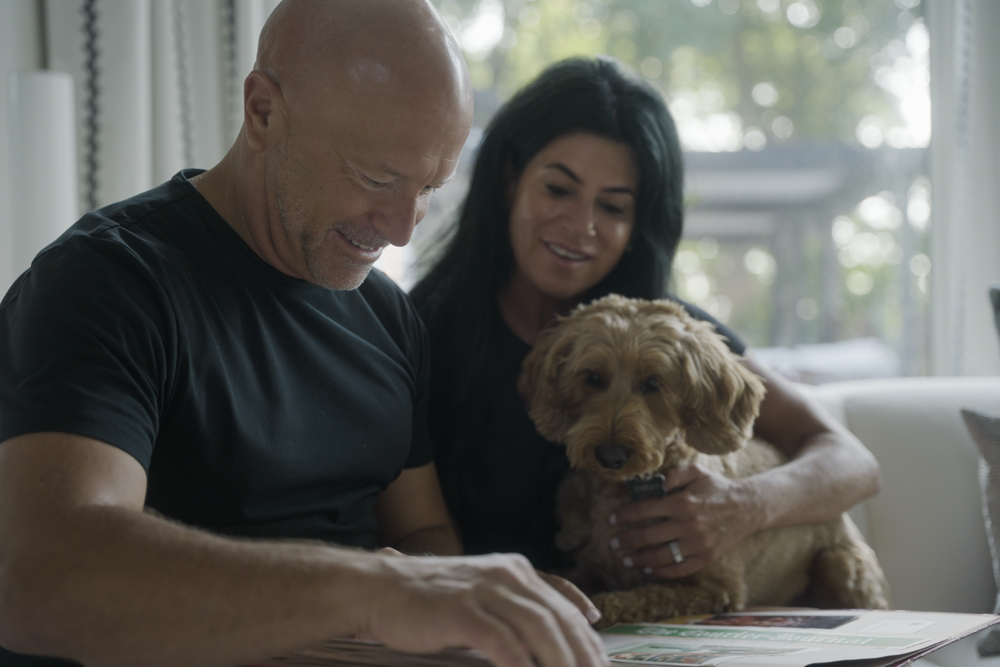
Cologuard — a simple way to screen
Built on the decades of research of Cologuard, the Cologuard Plus® test raises performance for a use-at-home screening test. It’s the leading non-invasive colon cancer screening test and designed to catch roughly 95% of colorectal cancers.[i],[ii]
It can be used in the privacy of your own home, with no specific prep, time off, or changes in diet. A sample is collected and mailed back to a lab with a pre-paid box. Under the Affordable Care Act, follow up colonoscopies are also covered by many health plans.[iii]
No symptoms, no warning. A silent cancer
For Aaron, when his Cologuard results came back, he was caught off guard.
“It was positive. I remember thinking, ‘Something doesn’t feel right,’” he said. “It wasn’t a diagnosis, but it was enough to know I needed to act fast.”
Like many people with early-stage colorectal cancer, Aaron had no symptoms. That’s one of the reasons screening is so important.
Today, more than 60 million Americans are not up to date on colorectal cancer screening, even though it is the second leading cause of cancer deaths in the United States.[iv],[v]
Colorectal cancer is also one of the most preventable cancers — yet early stages often go unnoticed without screening.[vi]
Aaron didn’t wait.
His next step was to have a follow-up colonoscopy. After the procedure was complete, he was given the news that they found a mass. It was cancer.
“You hear the word ‘cancer,’ and it just doesn’t feel real,” Aaron said. “I had no symptoms. None.”

Moving quickly — and staying positive
Within just a few weeks, Aaron had additional scans and surgery to remove part of his colon. The cancer had not spread to other organs, but it was classified as stage 3, meaning he would need chemotherapy.
“It felt like I kept getting knocked down over and over,” he said. Despite the challenges, Aaron leaned into the same mindset that had guided him as an athlete.
“If something’s wrong, let’s figure it out and fix it,” he said. “I stayed focused on getting healthy.”
From diagnosis to the end of treatment, the entire journey lasted just a few months.
Now, a few years later, Aaron is cancer-free.
Colorectal cancer rates are increasing in young adults
Dr. Michael Driscoll, Aaron’s doctor, knows how critical it is for people to stay up to date with their screening.
“If Aaron had waited, he could have had a much different outcome,” he said. “I’m seeing more and more young people get diagnosed with colorectal cancer. Screening, whether it’s with a colonoscopy or Cologuard is important.”
Today, colorectal cancer is the leading cause of cancer-related deaths among young adults less than 50.[vii] One-half of all colorectal cancer diagnoses are in people ages 45-49.[viii] The American Cancer Society recommends that adults at average risk begin screening at age 45 to help prevent cancer as well as detect early disease, which is more likely to be treated successfully.[ix]
Screening can make the difference
Today, Aaron shares his story openly, hoping it encourages others to take action.
“You’ve got to get screened,” Aaron said. “It’s too easy not to. Mailing in a Cologuard kit is a whole lot easier than going through cancer treatment.”
Aaron now spends his time traveling with his family, enjoying summers at the lake and continuing to run his business — grateful for the second chance that started with a simple screening test.
“I want to see my kids grow up, get married, have families of their own,” he said. “Getting screened gave me that opportunity.”
About the Cologuard test
The Cologuard test is intended to screen adults 45 years of age and older who are at average risk for colorectal cancer by detecting certain DNA markers and blood in the stool. Do not use if you have had adenomas, have inflammatory bowel disease and certain hereditary syndromes, or a personal or family history of colorectal cancer. The Cologuard test is not a replacement for colonoscopy in high risk patients. Cologuard performance in adults ages 45-49 is estimated based on a large clinical study of patients 50 and older. Cologuard performance in repeat testing has not been evaluated.
The Cologuard test result should be interpreted with caution. A positive test result does not confirm the presence of cancer. Patients with a positive test result should be referred for colonoscopy. A negative test result does not confirm the absence of cancer. Patients with a negative test result should discuss with their doctor when they need to be tested again. False positives and false negative results can occur. In a clinical study, 13% of people without cancer received a positive result (false positive) and 8% of people with cancer received a negative result (false negative). Rx only.
This story reflects on an individual’s experience. Not every person will have the same treatment, experience, outcome, or result. The Cologuard test is prescribed by your health care provider. Talk to your health care provider about available screening options and whether the Cologuard test may be right for you. There are potential risks associated with the Cologuard test and it may not be appropriate for all patients. For more information about the risks, talk to your health care provider or visit www.Cologuard.com for more information.
[i] Stieber B, Greene M, Ahn Le Q, et al. Trends in utilization of colorectal cancer screening modalities among patients with average risk in the United States from 2017 to 2023. J Clin Oncol. 2025; 43(4 Suppl):98.
[ii] Cologuard Plus Clinician Brochure. Exact Sciences Corporation. Madison, WI.
[iii] Departments of Labor, Health and Human Services, and Treasury. “FAQs About Affordable Care Act Implementation Part 51, Families First Coronavirus Response Act and Coronavirus Aid, Relief, and Economic Security Act Implementation.” Jan. 10, 2022. Q6-7. https://www.dol.gov/sites/dolgov/files/EBSA/about-ebsa/our-activities/resource-center/faqs/aca-part-51.pdf
[iv] Ebner DW, Kisiel JB, Fendrick AM, et al. Estimated Average-Risk Colorectal Cancer Screening-Eligible Population in the US. JAMA Netw Open. 2024;7(3):e245537. Published 2024 Mar 4. doi:10.1001/jamanetworkopen.2024.5537
[v] ACS. Cancer facts & figures 2026. Atlanta: American Cancer Society; 2026.
[vi] CDC. Reducing Risk for Colorectal Cancer. Updated February 26, 2025. Accessed May 20, 2026. https://www.cdc.gov/colorectal-cancer/prevention/index.html
[vii] Siegel RL et al. “Leading Cancer Deaths in People Younger Than 50 Years.” JAMA. 2026;335(7):632-634. Published Jan. 22, 2026.
[viii] ACS. Fast Facts Colorectal Cancer Statistics, 2026. Atlanta: American Cancer Society; 2026.
[ix] ACS. American Cancer Society Guideline for Colorectal Cancer Screening. Updated January 29, 2024. Accessed November 19, 2025. https://www.cancer.org/cancer/types/colon-rectal-cancer/detection-diagnosis-staging/acs-recommendations.html
