


When Garen was diagnosed with lung cancer, biomarker testing helped focus his treatment options, inform his treatment decisions, and finding the appropriate treatment has allowed him to maintain his active lifestyle.
When Garen went to his doctor about high blood pressure, he never expected the appointment would eventually lead to a diagnosis of HER2 (ERBB2)-mutant advanced non-small cell lung cancer (NSCLC).
“I had no history of cancer in the family, and I’ve been pretty good about taking care of myself,” he said. “I’m an avid outdoorsman, I eat well, I don’t smoke, and I rarely drink.”
Initially, he thought his persistent cough was a side-effect of his blood pressure medicine, but x-rays led to what he describes as “the three most difficult words you’ll hear in your life: ‘You have cancer.’”

The firehose
Garen has a science background, so he came to terms with his lung cancer diagnosis by gathering data. “The way I process information is, I ask a lot of questions, I do a lot of research, I talk to a lot of people,” he said.
Garen sought out discussions with several oncologists and surgeons, and even asked to speak to their patients so he could understand the risks and recovery. At times, these conversations felt like trying to “drink from a firehose” as there was so much information. “I’m really a detail-oriented person, so I tend to kind of gravitate towards overdoing it. But more data just helped me process the information, because once you make the decisions, you can’t take it back.”
The two months following his diagnosis were “a blur,” but one moment provided clarity: the results of his comprehensive biomarker test.

The power of knowledge
Biomarkers are caused by changes in DNA that can be measured to identify specific genetic mutations or proteins in cancer cells.1 A comprehensive biomarker test, also called next-generation sequencing (NGS), tells an oncologist if there’s a specific mutation in the tumor’s DNA, helping them predict which treatments are most likely to help.1,2 About 50% of patients with metastatic non-small cell lung cancer have an actionable biomarker.3,4

Vicky Brown
U.S. Therapeutic Area Head for Oncology and Emerging Areas, Boehringer Ingelheim
“It’s really important to ask very early on about biomarker testing,” said Vicky Brown, U.S. Therapeutic Area Head for Oncology and Emerging Areas at Boehringer Ingelheim. “If you don’t know if you’ve been tested for biomarkers, it’s almost like the initial diagnosis is incomplete, because each person’s cancer is unique.”
While there have been advancements in testing for biomarkers in recent years, there is still more progress to be made. In 2022, around 75% of patients with advanced NSCLC received biomarker testing.4 With cancer, waiting can be hard. You may want to start any treatment as soon as possible, to feel that you are doing something, but knowing your biomarker can open doors to more specific treatment options.4 Targeted treatments designed to address the underlying cause of tumor growth are available for certain biomarkers.4
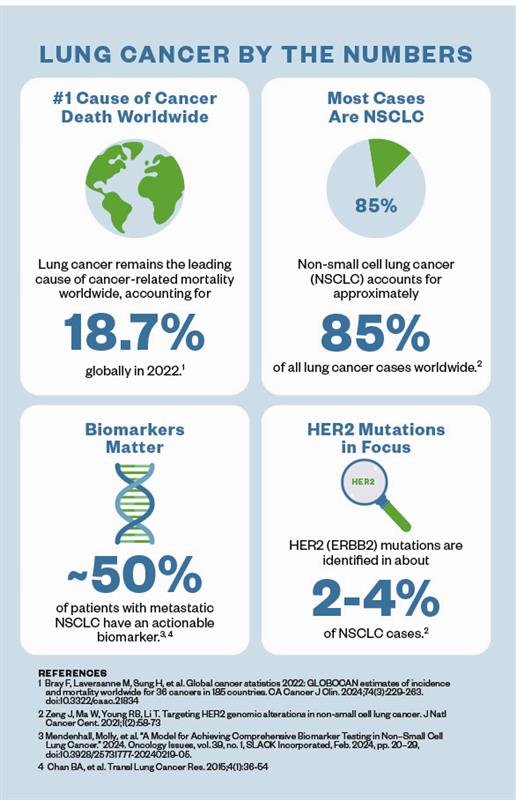
“It’s important to find an oncologist who will be a true partner in your care and take the time to answer your questions,” Brown noted. “Knowledge is power, so patients should feel empowered to ask whether comprehensive biomarker panel testing has been done, to review and understand the results, and to learn how those findings are guiding treatment decisions. If comprehensive testing has not been completed, it’s important to ask about having it done.”
“People don’t know what they don’t know,” Garen noted. “Biomarker testing may not always be standard practice, depending on where you live and your care team, but there are potential serious consequences with not knowing that information. So, ask about it!”
Testing that shapes treatment
Garen says he was fortunate – his care team reflexively completed a comprehensive biomarker test when taking a biopsy and helped him understand the results. The test confirmed he had a form of lung cancer with a HER2 mutation. “Knowing my biomarker – a HER2 mutation – focused my treatment options,” Garen explained.
This information helped his care team determine the treatment that would be best for him.
“I’ve been feeling good and can continue my favorite activities,” Garen noted. “Hiking in the mountains, skiing or snowboarding with my boys, or riding my bike and doing some of the other things I love to do.”
Brown also notes that even if you don’t have an “actionable” biomarker — meaning there’s currently no existing targeted therapy for it — testing may still be important to determine the right treatment path.
“Targeted therapies, even for very rare mutations, are more frequently being developed and approved,” she said. “The landscape within oncology is evolving very rapidly.”
Hang onto hope
Garen knows a cancer diagnosis can be overwhelming. “It’s a grieving process,” he said. “The only way to make the right decisions is to educate yourself and advocate for yourself. Your doctors can be a great resource. Talk to other patients. There are nonprofits I’ve connected with, like GO2 for Lung Cancer, LUNGevity Foundation, and the International Cancer Advocacy Network (ICAN), group sessions and group support network forums that you can participate in. There’s no one-size-fits-all — find the one that works for you.”

Brown says she’s proud to be part of a team at Boehringer Ingelheim that is bringing new hope to people with cancer. “Continued scientific advancements will lead to more personalized treatment options, as we’ve seen with our recent approvals in biomarker-driven tumor types,” Brown said. “But we know there is still so much more to do. For us, each approval is not the end point; it’s a reminder to keep pushing forward and developing new targeted therapies, cancer cell-directed and immuno-oncology treatments and combination approaches that may help even more patients, and bring more hope, in the future.”
Garen has hope and can look forward to more outdoor adventures because of that comprehensive biomarker test.
“My advice to anyone dealing with cancer is, ‘you have to hang onto hope,’” he said. “For me, life seems to be in a bit more Technicolor than it was before. You appreciate it, you experience it a little more vividly.’”
For more information about biomarker testing and HER2-mutant NSCLC, click here
Always seek the advice of your physician or other qualified healthcare provider concerning questions you have regarding a medical condition, and before starting, stopping or modifying any treatment or medication.
References
- Odintsov I, Sholl LM. Prognostic and predictive biomarkers in non-small cell lung carcinoma. Pathology. 2024;56(2):192-204. doi:10.1016/j.pathol.2023.11.006.
- American Lung Association. Lung cancer biomarker testing. https://www.lung.org/lung-health-diseases/lung-disease-lookup/lung-cancer/symptoms-diagnosis/biomarker-testing. March 12, 2026.
- Offin M et al. Cancer. 2019;125(24):4380-7.
- Chan BA, et al. Transl Lung Cancer Res. 2015;4(1):36-54.
- Hage Chehade C, Ozay ZI, Jo Y, et al. Trends and Disparities in the Use of Next-Generation Sequencing in Patients With Cancer in the United States. JAMA Netw Open. 2026;9(4):e265585. doi:10.1001/jamanetworkopen.2026.5585
