Disability has an image problem. We have to change the way we think about it.

Kasey Minnis
Executive Director, Multiple Sclerosis Foundation
As a nation, we have come a long way in our collective view of disability — we’ve made great strides from a time where people with disabilities were feared, hidden away, or openly pitied (see sidebar). But the mistaken image and limited understanding of disability in the public consciousness today prevents millions — quite possibly you or a loved one — from accessing their full rights under the law. It prevents people from continuing to work, access education, receive healthcare, and fully enjoy life. We need to think differently about disability.
Who exactly is disabled?
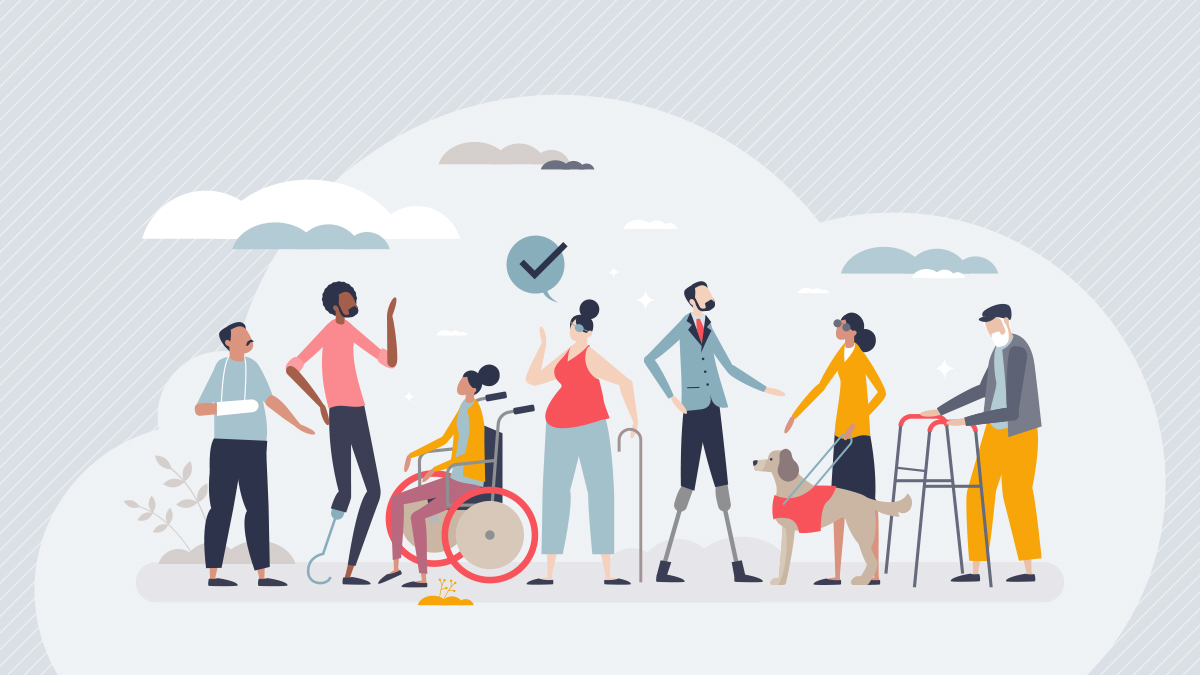
Disability is not something that’s typically explicitly defined for us; we form our ideas about what disability means from what we see in the media and from our own interactions and observations. Some people’s perceptions are informed by the Social Security Administration’s requirement for disability payments — you’re disabled if you’re completely unable to work. Others have their ideas influenced by who qualifies for disabled parking permits — individuals with mobility impairments or conditions that make them unable to walk for some distance. And of course, generally we hear the term applied to individuals with visible disabilities, such as limb loss, the need for a ventilator or portable oxygen, or wheelchair users.
But what really is disability? The guiding document for disability rights in the United States, the Americans with Disabilities Act (ADA), defines a disability as having “a physical or mental impairment that substantially limits one or more major life activities.”
What are “major life activities” that are limited when you have a disability? These include some that are intuitive, such as walking, working, seeing, and hearing, but also some things you may not have considered. The law considers the following to be some of our major activities of life:
- Caring for oneself: Daily activities like eating, sleeping, waking, grooming and dressing.
- Mobility: Walking, standing, lifting, bending, and performing manual tasks.
- Sensory: Seeing, hearing, touch and pain, and sensory-sensitivity disorders.
- Communication: Speaking, understanding, and reading.
- Cognitive: Thinking, concentrating, learning, and remembering.
- Working: Performing the essential functions of a job.
- Major bodily functions: immune system functions, normal cell growth, digestive functions, bowel and bladder functions, neurological and brain functions, circulatory and respiratory functions, endocrine and reproductive functions.
If you are substantially (not necessarily totally) limited in any of these major life activities, you qualify as disabled by law. Let’s examine what this means in practical terms. Could a person with migraine, chronic insomnia, arthritis, heart disease, asthma, or other common health conditions qualify under the law as disabled while still being able to work, to drive, to walk, to participate in most aspects of life? Yes. Could a person who is only temporarily impaired, such as someone battling cancer or recovering from major surgery, qualify? Yes. Could someone with an illness that causes an impairment to come and go, such as relapsing forms of MS or autoimmune diseases that flare up like lupus, qualify as disabled under the law? Yes.
Under the ADA, disability does not have to be total or permanent in order to qualify for protection. Regardless of whether you can work, regardless of whether you can walk, if you experience significant impairment of major life activities, you have protection under the ADA and can request accommodation for your needs, both at work and in public settings.
Viewing disability by this broader definition demonstrates something important, and this thought may shock some people: Being disabled is a normal part of the human experience.
Is disability normal?
According to the Centers for Disease Control and Prevention, 28.7% of the U.S. population has a disability — more than 1 in every 4 persons. As we age, that number naturally increases. Even as medical science rapidly improves and life expectancy grows, disability still catches up with us. Nearly half of all people over 75 have a disability. Even if medical science someday advances to the point of curing diseases, congenital defects, and the effects of aging, accidents and injuries still occur. Disabled people have always, and likely will always, be among us. Being disabled is a human norm.
But while disability is normal, unfortunately, accommodation is not. Among those with multiple sclerosis (MS), for example, only 15% of people will become what is considered “severely disabled.” And yet, within 10 years of diagnosis, half of people with MS are unemployed. Why? Failure to accommodate their disability by employers.
The autism community sees a similar trend, with some studies showing 85% of autistic adults with a college degree are unemployed. Oftentimes, the accommodations asked for are small and cost-effective for both groups — quiet work areas with few distractions, allowing the use of note-taking software or providing written instructions, and limited additional break time for recovery. Yet employers are uneducated about the rights of individuals with these conditions and the benefits of accommodating them. Why?
In part, this is because so many of us who qualify as disabled under law and could fight for more accommodating environments do not consider ourselves disabled or identify with the disability community. As a result, disability advocacy has largely fallen on the individuals who have the greatest obstacles to overcome. This hurts all of us.
If you are chronically ill, even if your major life activities are not yet significantly impaired, chances are you could already benefit from an atmosphere of accommodation. If you have migraines, wouldn’t it be great if your employer provided low-cost filters for overhead lights and computer screens on request? If you’re losing your hearing, wouldn’t you prefer if restaurants had an area where background music could be lowered so you could hear your companions? If you have insomnia, wouldn’t you like to be able to ask a hotel for a room away from the elevator and ice machine, and be confident you will be accommodated? We do not live one-size-fits-all lives, but our work, our education, our healthcare, and even our recreation are arranged as though we do, with little thought given to accommodating different needs.
These are low-stakes examples, but in the case of healthcare in particular, the stakes can be high. Recently, my mother, who is hearing-impaired, was in the hospital with a potentially life-threatening issue. Our local hospital had rolled out new technology meant to improve nursing care. In addition to the nurses on the floor, a telehealth nurse would periodically appear on a screen and could see the patient through a webcam. This nurse’s responsibility was to keep the patient informed about their care and the doctor’s instructions. Only, there was no closed captioning for the screen. Even at the screen’s highest volume, my mother could not hear her and could only rely on lip-reading. She had no way to be sure she understood what was being conveyed to her and had to insist on an in-person nurse. How little thought was given to accommodating people with hearing disabilities when developing this system? And how dangerous would the situation have been had my mother not strongly advocated for her needs to be accommodated?
Join with the disability community
With more than a quarter of the U.S. population experiencing disability at this moment, chances are good that you or someone you love is among that number. If that’s not currently true, it almost certainly will be in the future. Disability rights, disability law, and the accommodation of disabled people should matter to you — to each of us. What can you do to help? Here are three important steps:
| People with disabilities | Those who care for them | |
| LEARN | Learn more about your rights under the law. ADA.gov has a great overview of disability rights legislation. | Disability rights organizations like DREDF.org and NDRN.org are great places to learn about current issues. |
| SPEAK | If “disabled” applies to you by law, own it. Even if you are currently able to compensate for your disability and don’t need accommodations, you can be a welcome part of the disability community. | Normalize disability. It’s not a dirty word; don’t be afraid to say it. Listen to individuals who are disabled, and try to understand their experiences and needs. |
| FIGHT | If you are disabled and would benefit from accommodations, ask for them. Fight for them. The trail you will blaze clears the way for the next person. AskJan.org is an invaluable site for learning what kind of accommodations can be made in the workplace, but don’t hesitate to ask for them in education, healthcare, and other settings. | Stand up for others. Advocate for your loved ones in school and in healthcare. If you are an employer, be thoughtful about your approach to accommodating employees. The ADA calls for an interactive process meant to create win-win situations for the employer and employee. |
We have come a long way from a time when disability was viewed as a source of shame, but we still have far to go in viewing disability as it actually is — part of the normal-range human experience. By normalizing disability, we move closer to allowing people with disabilities full participation in life. We also move toward a society that is more accepting of individual needs, which benefits each of us.
A Brief History of Disability in the United States
Industrial Revolution: The first Industrial Revolution coincided with the founding of the United States. There were long working hours, no safety regulations, and little access to medical care, so acquired disability was commonplace. Those who became disabled often had no recourse but begging, and — in a time that prioritized productivity — were objects of scorn.
Civil War: Hundreds of thousands of soldiers injured, with around 20,000 amputees. Asylums and sanitariums began to be created to warehouse those who had served.
Reconstruction to World War I: The so-called “Ugly laws” were enacted in many cities — New York, Chicago, Denver, New Orleans, Portland, and more — which sought to prevent begging by disabled people by making it illegal for a person with a visible disability to be seen in public.
1907 Immigration Act: People who were found by an examining surgeon to be mentally or physically defective, affecting their ability to earn a living, were not permitted to enter the country, even if family members committed to financially supporting them.
1907-1940 eugenics laws: Laws enacted in 30 states allowed for the forced sterilization of the developmentally disabled, mentally ill, and those with substance use disorders. The last recorded involuntary sterilization under these laws occurred in the 1980s.
1938 Fair Labor Standards Act: Made it legal to pay those with disabilities less than minimum wage. This law is still in force.
1968 Architectural Barriers Act: The 1960s saw the launch of the disability rights movement in the United States. This act required federally owned or leased buildings to be accessible to the disabled.
1973 Rehabilitation Services Administration established: This agency was tasked with overseeing vocational rehabilitation programs to help disabled people become or remain employed.
1975 Individuals with Disabilities Act: For the first time, children with disabilities were guaranteed the right to be integrated in public schools.
1990 The Americans with Disabilities Act (ADA): The ADA not only protects the rights to access of persons with disabilities, but also made it illegal to discriminate on the basis of disability for the first time.
