
What happens after breast cancer treatment ends? For the more than 4 million American women living as survivors of breast cancer right now, finishing their initial treatment actually just starts a new phase of care: survivorship.

Steven Chen, M.D., M.B.A.
Chief Medical Officer, ImpediMed
Cancer survivorship goes past treatment to focus on rebuilding strength, protecting function, and preventing complications that can appear months or even years later. Managing quality of life isn’t secondary, but is often forgotten or can feel secondary to just focusing on survival.
Lymphedema is one of the most feared complications that can follow cancer treatment. It often begins subtly, as small shifts in fluid or tissue composition are not always visible or painful at first. Up to 1 in 5 breast cancer patients and survivors experience breast cancer-related lymphedema. At the same time, many undergo subtle but significant shifts in body composition. Screening reveals that roughly 40% of breast cancer survivors have low muscle mass, while others experience persistent fatigue or unexplained weight changes, all of which can negatively impact quality of life. These shifts often occur long before noticeable symptoms emerge or between follow-up visits with a physician.
Survivorship care works best as a measurable journey that combines clinical expertise with consistent, objective data. A pre-treatment baseline helps clinicians understand what a patient’s norm looks like before cancer treatment begins. Routine follow-up measurements for each individual patient offer a clear picture of what’s happening inside their body, even if they don’t look or feel different. This enables clinicians to introduce conservative therapies, prescribe exercise and nutrition plans, and connect patients with support before early issues become bigger problems.
A tool for real-time, personalized care
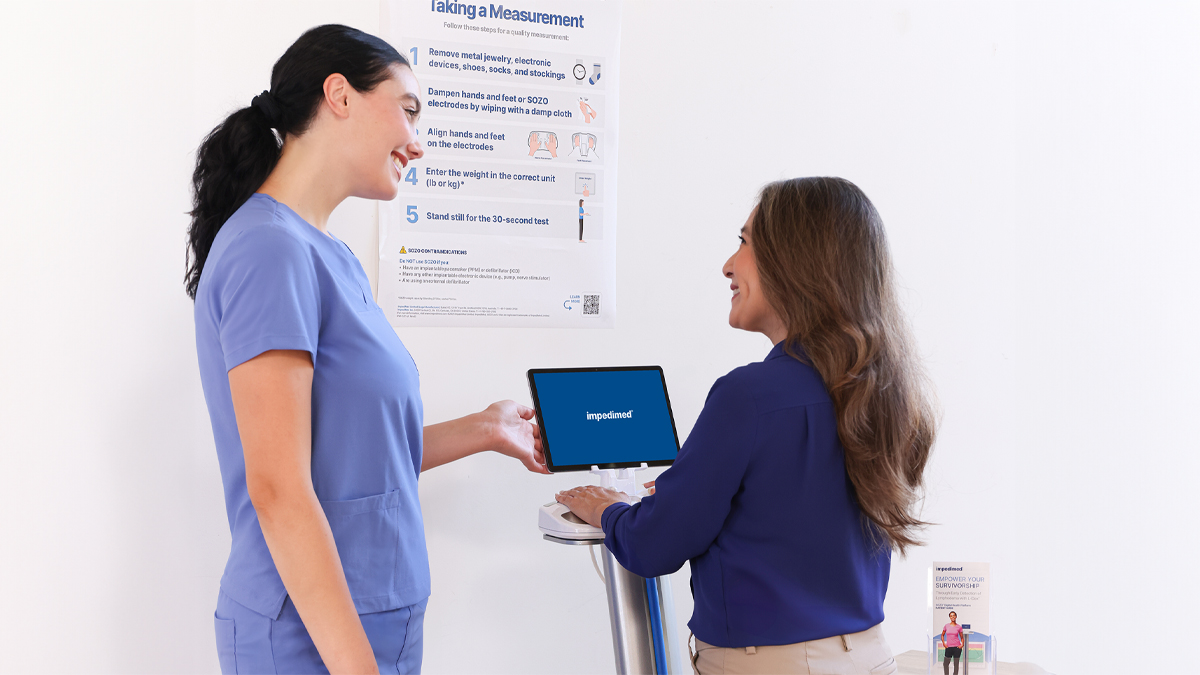
Bioimpedance spectroscopy (BIS) is one tool that makes this possible. ImpediMed’s SOZO® Digital Health Platform is the only FDA-Cleared BIS technology that non-invasively measures fluid status and tissue composition, and is cleared for use in both healthy and unhealthy populations. Because fluid shifts can be one of the first and most sensitive signs of change, BIS enables clinicians to monitor for subclinical lymphedema and other key health indicators, such as changes in skeletal muscle mass and fat mass, providing them with the whole-body insights for real-time, personalized care.
For patients, BIS data combined with clinical assessments can provide clarity and empowerment. Seeing progress, even in one small measurement, can turn uncertainty into action, build confidence, and encourage adherence to treatment plans. For clinicians, it creates a shared language across the care continuum. Everyone, including the patient, sees the same trends, and care decisions become more timely, coordinated, and meaningful. BIS doesn’t only provide a baseline assessment, but an anchor for the regular check-ins, defined thresholds, and consistent care upon which strong survivorship programs are built.
Survivorship is about more than finishing treatment. It’s about protecting and thriving in the life ahead. When we combine meaningful data with compassionate and thoughtful care, survivors gain more than reassurance. They gain control, strength, and the ability to move confidently through survivorship.
To learn more, visit impedimed.com
