
For well over 100,000 U.S. women who undergo a mastectomy annually, breast reconstruction is still widely considered the standard of care.[i] A growing chorus of survivors’ voices show that “going flat” can offer just as much comfort and confidence following a mastectomy, and prosthetics provide a flexible middle ground. Empowering patients begins with ensuring they understand every option available.
Amid the overwhelm of emotions and medical appointments that follow a breast cancer diagnosis or news of elevated breast cancer risk, one of the most difficult decisions women face is what to do after breast tissue removal.
The avalanche of decisions
That was the case for Kelsie Barnhart, who was diagnosed with stage 2 invasive ductal carcinoma just after her 27th birthday — a shock, considering women under 40 account for just 2% of ductal carcinoma cases.[ii]
In the early whirlwind weeks, “there are a lot of decisions to be made very quickly,” recalled Barnhart, who opted for a single mastectomy after meeting with specialists in oncology, surgery, and plastic surgery. I quickly picked up on the assumption by various doctors that I would pursue reconstruction. The plastic surgeon was very clear with his opinion, saying, ‘You should let me do this. You’re so young.’”
Barnhart had reservations. “Did I want a foreign substance in my body? Was I willing to have surgeries to replace the implants multiple times throughout my lifetime? Did I want to have a double mastectomy instead to keep things ‘even’? What were the risks of an implant moving or leaking? My priority was having the cancer removed.”
Finding a new community
Barnhart began researching her options, and discovered the “Going Flat” movement, a growing community of women who made the choice not to have breast reconstruction after their mastectomy. She saw that there were as many “going flat” stories as there were survivors. “Young patients, old patients, married patients, single patients — everyone had different reasons!”
A growing body of research backs up what these women are finding themselves: Satisfaction and confidence are not limited to those who choose reconstruction.[iii]
Choosing a middle ground
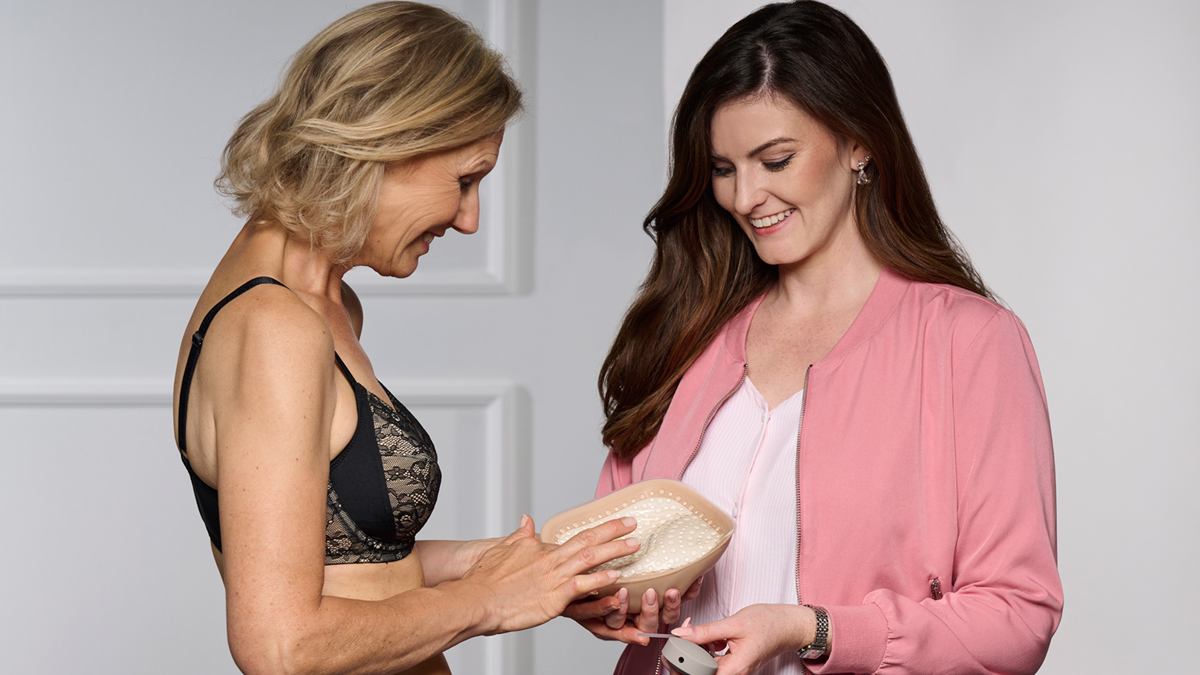
It wasn’t until Barnhart declined reconstruction that her surgeon mentioned breast prosthetics — lightweight, removable breast forms designed to restore symmetry and a pre-mastectomy silhouette under clothing. Initially hesitant, she decided to explore the option.
That’s when she found Amoena, a company that has been designing prosthetic breast forms and post-mastectomy apparel for half a century. When she saw “the quality of the material and the variety of breast form shapes and sizes,” she thought: “OK, this could really work for me.”
Today — seven years since her diagnosis — Barnhart wears Amoena’s Contact Form, which has a reusable adhesive layer that keeps it secure during activity. “I can wear a racer-back tank top to a yoga class or put on all my gear for the rock-climbing gym, and the breast form will stay in place for a full 12-hour day of activity,” she shared. “I can wear a slip dress to a holiday party or a t-shirt around home and feel like the most comfortable version of myself.”
She highlighted the flexibility prosthetics offer her: “Some days I might choose to leave the prosthetic at home, but I love that I have an option for whatever mode I am feeling in that day”.
Closing the awareness and access gaps
Stories like Barnhart’s reveal two critical barriers: awareness and access. Too often, women are not told about prosthetic options early enough to make a fully informed decision. According to a survey by the American Society of Plastic Surgeons, about half of U.S. women are unsure that surgical alternatives beyond implants exist.[iv]
Amoena hopes to change that. As the company celebrates its 50th anniversary, it continues to innovate prosthetic design — developing lighter, more adaptive materials — and to advocate for broader awareness among patients and providers alike.
But access remains a challenge. While Amoena products are typically covered by insurance for women who have undergone mastectomies, reimbursement rates have remained stagnant for years, even as tariffs and production costs have risen. To address this, Amoena has organized a lobbying coalition to advocate for fair reimbursement and to prevent rising costs from being passed on to patients.
Meaningful access is also constrained by current Medicare policy. While Medicare provides limited coverage for basic external breast prostheses, many of the advanced components women rely on today — such as adhesive breast forms, specialized post-mastectomy garments, and newer lightweight technologies — are not covered at all. Even for the items that are eligible, Medicare reimbursement rates have remained grossly inadequate for decades, failing to reflect real manufacturing costs or clinical value. As a result, women on Medicare, including a large share of older breast cancer survivors, often face significant out-of-pocket expenses or are forced to go without products that are essential to their comfort, mobility, and body symmetry. Closing this reimbursement gap is essential to achieving true equity in post-mastectomy care.
An empowered choice
For Barnhart, the decision not to reconstruct wasn’t about rejecting femininity — it was about reclaiming control. “It is my hope that each breast cancer patient can look in the mirror and be so proud of what their body has endured and the treatment decisions they have made, whatever that may be,” she shared. “But in order to make decisions you are proud of, you need to know all of the options. That is where the responsibility lies with our medical community. Prosthetics need to be discussed just as early as plastic surgery and with full transparency.”
As Amoena marks 50 years of innovation, the company continues to champion the same message survivors like Kelsie are voicing: Every woman deserves not just recovery but choice.
To learn more and shop Amoena’s full line of prosthetics, visit amoena.com
Citations
[i] Brigham and Women’s Hospital. (n.d.). Mastectomy. Brigham and Women’s Hospital. https://www.brighamandwomens.org/surgery/surgical-oncology/resources/mastectomy.
[ii] American Cancer Society. Breast Cancer Facts and Figures 2024-2025. Atlanta, GA: American Cancer Society (2024). https://www.cancer.org/content/dam/cancer-org/research/cancer-facts-and-statistics/breast-cancer-facts-and-figures/2024/breast-cancer-facts-and-figures-2024.pdf
[iii] Baker, J.L., Dizon, D.S., Wenziger, C.M. et al. “Going Flat” After Mastectomy: Patient-Reported Outcomes by Online Survey. Ann Surg Oncol 28, 2493–2505 (2021). https://doi.org/10.1245/s10434-020-09448-9
[iv] American Society of Plastic Surgeons. (2022, October 24). Survey: Many U.S. women lack basic information on life after mastectomy. https://www.plasticsurgery.org/news/press-releases/survey-many-us-women-lack-basic-information-on-life-after-mastectomy
